Come home safe.
The Scottish hills are magnificent and unforgiving. This is the essential pre-trip briefing our Mountain Rescue teams wish every hillgoer read, the kit, the forecasts, and how to call for help if it all goes wrong.
Before you go
- ✓Check MWIS and the Met Office mountain forecast - evening before AND morning of.
- ✓Winter? Read the SAIS avalanche forecast and pick a route that matches it.
- ✓Leave a route plan with someone at home, plus your expected return time.
- ✓Check daylight hours and set an honest turnaround time.
- ✓Register your phone for Emergency SMS (text 999) - must be done in advance.
- ✓Download OS Locate and what3words. Save maps offline.
- ✓Fully charge your phone. Take a power bank.
- ✓Pick a route that matches the weakest member of your party.
The essentials - always in the pack
Not a wish list. Every one of these has saved a life on a Scottish hill.
OS 1:25 000 or Harvey. Know how to use them without the phone.
Jacket AND trousers. Scottish weather turns in minutes.
Fleece or synthetic mid-layer plus a spare, hats and gloves year-round.
Even for a summer day walk. Batteries, or a second torch.
Storm whistle, group bothy bag or emergency shelter.
Blister care, trauma dressing, foil blanket, personal meds.
1.5 – 2 L water, real food plus emergency rations you never touch.
Fully charged. OS Locate and what3words downloaded offline.
Sunblock and glasses, snow, high cloud and ridges all burn.
Drink and eat little and often. Don't wait until you're empty.
Winter add-ons (October to May)
- Ice axe (and the training to self-arrest)
- Crampons compatible with your boots (B1/B2/B3)
- Goggles for spindrift and whiteout
- Helmet on any snowed-up or icy ridge
- Read the SAIS forecast, pick a route that fits it
- Shorter daylight, start earlier, turn back sooner
On the hill
- Navigate off the phone. Cold kills batteries. Map, compass and pacing beat a dead screen in cloud.
- Respect the turnaround time. The summit is optional. Getting off the hill is not.
- Watch the group. Move at the pace of the slowest. Regroup at every junction.
- River crossings. Never cross a spate. Unlink packs, face upstream, side-step across. If in doubt, walk upstream.
- Winter cornices. Stay well back from corniced edges, they overhang further than the map suggests.
- Bad weather closes in. Descend early. The mountain will be there next weekend.
Dogs on the hill
Ruadh, Glenn's red labrador, has stood on many of these summits. A dog on the hill is a joy, and a second life to look after. Treat their day with the same planning as your own.
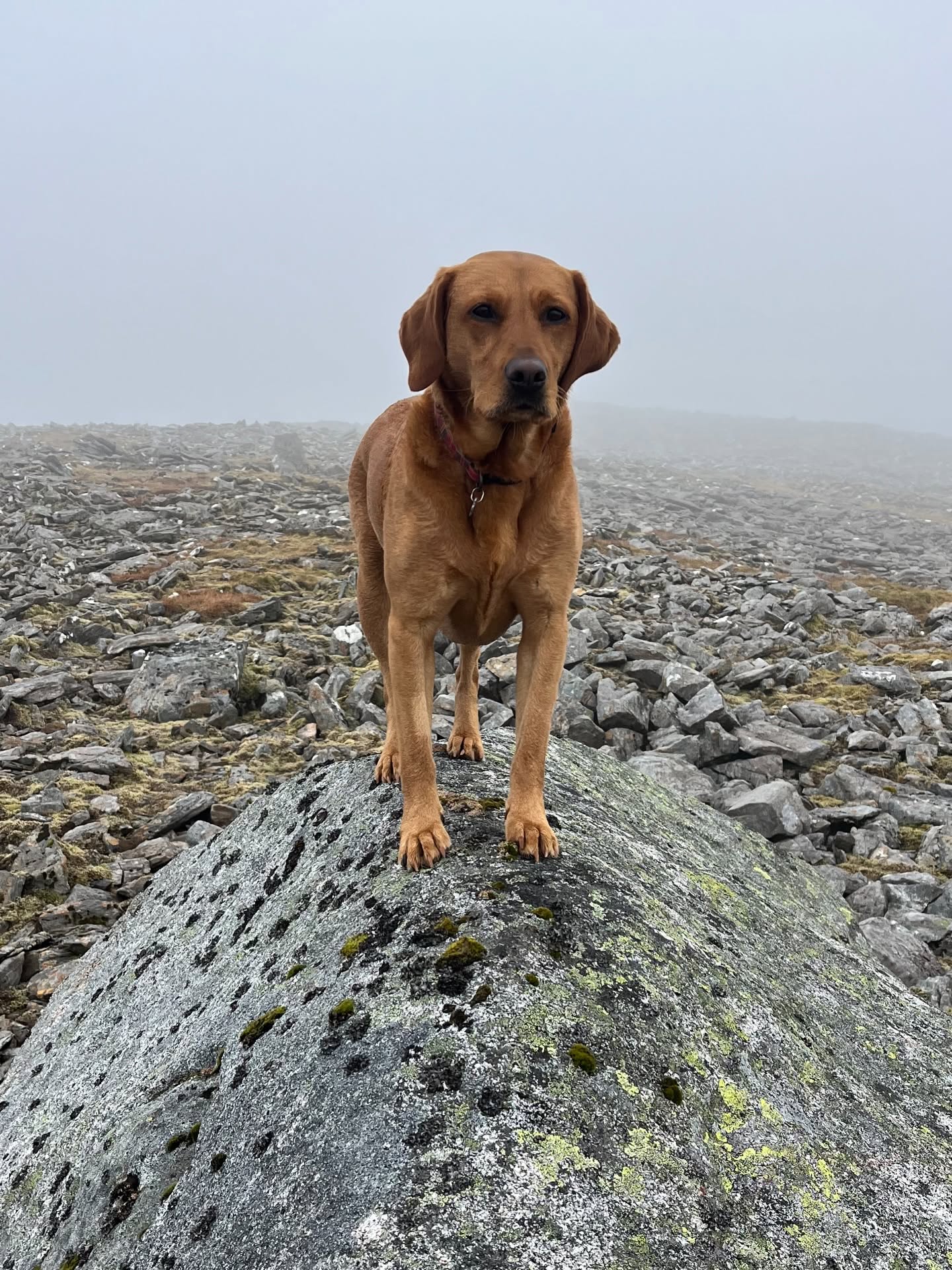
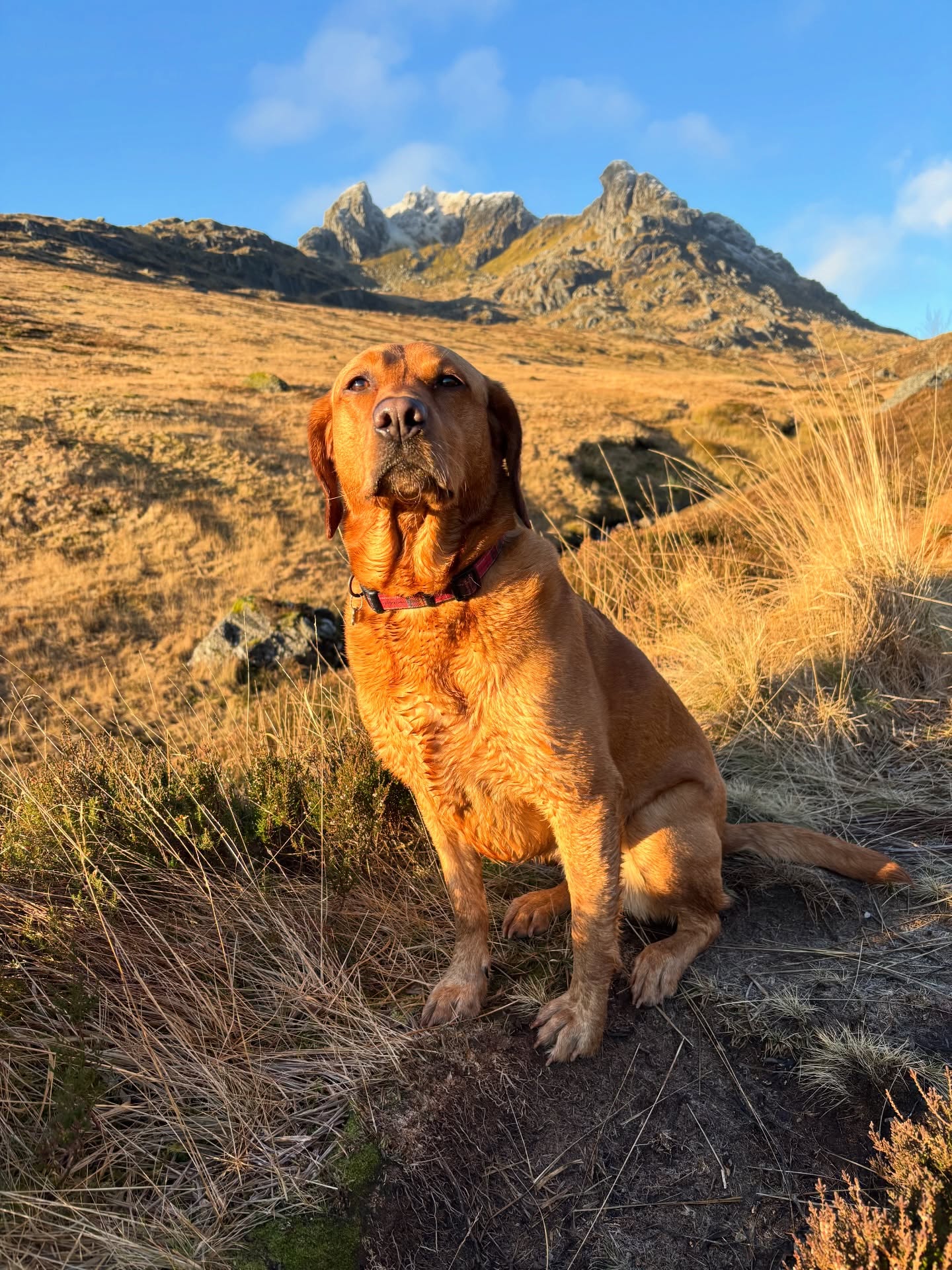
Is your dog ready?
- Build up gradually, hill days are far harder than pavement walks.
- Very young (under 12–18 months), elderly or brachycephalic breeds (dogs with shortened snouts and flattened faces e.g., Pugs, French and English Bulldogs, Boxers, and Shih Tzus) should sit out big Munro days.
- Know their honest limit before the summit push, not after it.
- Vaccinations, tick prevention and worming up to date.
In the dog's pack (or yours)
- Collapsible bowl, extra water, high-calorie food.
- Harness with a grab handle for lifts over rock steps; short lead.
- Dog first aid: vet wrap, bandage, saline, tick remover, paw balm.
- Foil blanket sized for the dog, plus a spare towel.
- ID tag with your mobile, microchip current, poo bags carried out.
Access & wildlife (Scotland)
- Scottish Outdoor Access Code: under close control at all times.
- Short lead 1 April – 31 July for ground-nesting birds.
- Short lead near all livestock; avoid lambing fields entirely.
- Never let a dog chase deer, mountain hares or sheep.
Terrain hazards
- Scree and quartzite ridges shred pads — the In Pinn, An Teallach and Aonach Eagach are no-go for dogs.
- Cornices and steep snow — a slipping dog can pull the human off with it.
- Bog holes and peat hags, dogs disappear quickly. Keep eyes on.
- Rivers in spate, carry small dogs; never send a large dog across.
Weather & temperature
- Heat above ~20 °C is dangerous — especially for dark-coated dogs. Start early, rest in shade.
- Wet + windy summits chill dogs fast. A dog coat helps older or short-haired dogs in winter.
- Ice can ball between pads — check every hour on frozen ground.
- Signs of trouble: heavy panting that won't settle, stumbling, refusing to walk — stop, cool or warm, feed water and food.
Ticks, adders & carrion
- Check ears, armpits, belly and between toes at every break, and again at the car.
- Adders active April – September on sunny heather banks. If bitten, carry the dog and go straight to a vet.
- Keep dogs away from dead deer or sheep — botulism and other bacteria kill fast.
- Stop, shelter, warm the dog with your own layers or a foil blanket.
- Carry small dogs; improvise a stretcher with a jacket and walking poles for larger dogs.
- Mountain Rescue teams will assist with dog casualties - call 999 → Police → Mountain Rescue and be clear it's a dog. Never put yourself at risk retrieving a dog from a cliff or crag.
- SARDA Scotland - the volunteer search dog handlers who work alongside Scottish MR teams.
- Lost dog: stay at the point they were last seen if safe, whistle, call - don't scatter the party.
If it goes wrong
- 1STOP
Stop, shelter, assess. Get out of the wind, add layers, get calories in.
- 2Call 999 or 112
Ask for Police, then Mountain Rescue. Even one bar of signal carries an emergency call.
- 3No signal? Text 999
Only works if you pre-registered. Give location, casualty, party size, weather.
- 4Share your location
Six-figure grid reference, OS Locate, or what3words. Read it back twice.
- 5Stay put and stay visible
Group shelter up, torches on, whistle in six-blast bursts. Let the team come to you.
Weather & conditions
The forecast Scottish hillgoers trust. Read the West Highlands, Cairngorms and Southern Uplands panels the night before AND the morning of.
Freezing level, cloud base and wind speed by height band. Cross-check with MWIS.
Scottish Avalanche Information Service. December–April, essential on any winter route.
Live strike map. Ridges and metalwork are no place to be in a thunderstorm — descend.
Mountain Rescue & support
Volunteer teams, unpaid and on-call 24/7. Donations fund kit, training and callouts.
Skills courses, safety guidance and access advice for Scottish hillgoers.
Texting 999 only works if you register your phone in advance. Do it now, from home.
Your rights and responsibilities on the hill — wildlife, ground-nesting birds, deer stalking seasons.
Support Scottish Mountain Rescue
Every Scottish Mountain Rescue team is a charity, staffed by volunteers who leave family dinners and warm beds when the pager goes. If these hills have given you something, please give something back.
This page is guidance, not a substitute for training, experience, and up-to-date conditions. Always assess your own party's fitness, skills and the forecast on the day. If in doubt, turn back.